Tech Digest – March 18, 2026
AI Capabilities at the Frontier
GPT-5.4 Mini Outperforms Its Predecessor at Twice the Speed — Nano Follows
OpenAI released GPT-5.4 mini and nano, with mini surpassing GPT-5 mini across coding, reasoning, multimodal understanding, and tool use at twice the speed — approaching the full GPT-5.4 on benchmarks including SWE-Bench Pro and OSWorld-Verified. The nano variant targets lightweight, high-volume deployment scenarios.
Note: A smaller, faster model outperforming the previous generation’s full-size release is the pattern that drives enterprise adoption. The coding and tool-use gains are what land in institutional software workflows first — often before a procurement decision has been made.
Sources: OpenAI
A Trillion-Parameter Mystery Model Appears on OpenRouter — Suspected DeepSeek, Unattributed
A model calling itself “Hunter Alpha,” reportedly at the trillion-parameter scale, surfaced on the OpenRouter platform without attribution, generating significant attention among developers who reported strong performance. Speculation centers on DeepSeek stealth-testing its next generation in the open. No official confirmation has been made.
Note: The capability landscape is no longer legible from official announcements alone. A state-backed lab may be benchmarking frontier models in public before acknowledging their existence — which means institutions relying on formal vendor disclosures to time their AI planning are working with incomplete information.
Sources: Reuters
AI Solves Open Math Problems — and the First Autonomous Mathematician Agent Is Now Live
HorizonMath, a benchmark of over 100 predominantly unsolved mathematical problems, found that GPT-5.4 Pro has already resolved two open problems, proposing novel solutions that improve on the best-known published results. Separately, Harmonic released Aristotle Agent — described as the world’s first autonomous mathematician — currently available free of charge and ranked first in formal mathematics.
Note: When AI produces results that human researchers cannot yet verify, the planning assumption that “humans review AI outputs” starts to break down. For institutions building oversight frameworks around AI-assisted work, this is the scenario those frameworks need to address.
Sources: HorizonMath, Harmonic / X
US Department of Energy Commits $293 Million to AI-Driven National Science Challenges
The US Department of Energy announced the Genesis Mission — $293 million directed at applying novel AI models to over 20 national challenges spanning advanced manufacturing, biotechnology, critical materials, nuclear energy, and quantum science.
Note: A $293M federal commitment across domains that overlap directly with EU industrial strategy and the Digital Decade framework signals that AI-accelerated R&D is becoming a line item in national competitiveness budgets — not a research curiosity. EU institutions tracking science and industrial policy should note the reference point.
Sources: US Department of Energy / X
Agentic Platforms Take Shape
Anthropic Ships Persistent Desktop Agent — Jensen Huang Calls OpenClaw “The Next ChatGPT”
Anthropic released Dispatch inside Claude Cowork: a persistent agent that runs on a user’s computer and can be messaged from a phone, resolving the cloud-vs-local architecture question that has complicated agentic deployments. Nvidia CEO Jensen Huang, speaking at GTC, described OpenClaw as “definitely the next ChatGPT” — the clearest signal yet from a hardware leader that agentic platforms, not chat interfaces, define the next deployment phase.
Note: The architecture choice matters for institutions: a persistent agent running locally against approved content and local systems is a fundamentally different compliance and data-handling proposition than a cloud-hosted assistant. This is the model that makes institutional deployment tractable — and the race to define the standard is now openly acknowledged.
Sources: CNBC, Aakash Gupta / X
Microsoft Moves Mustafa Suleyman to First-Party AI Model Development
Microsoft is repositioning Mustafa Suleyman — formerly head of Microsoft AI — to lead first-party AI model development, reducing the company’s dependence on third-party frontier labs including OpenAI. The move signals that Microsoft intends to build its own frontier model capability rather than rely indefinitely on its OpenAI partnership.
Note: For public institutions with Microsoft enterprise agreements, this is a material planning signal. The AI capabilities embedded in Microsoft 365 and Copilot products may increasingly derive from Microsoft’s own models — with different capability trajectories, pricing structures, and data handling terms than those of the current OpenAI-backed stack.
Sources: CNBC
Geopolitics & Infrastructure
Nvidia Wins Beijing Approval to Sell H200 Chips to China — While Microsoft and OpenAI Head to Court
Chinese authorities approved Nvidia’s H200 AI chip for sale in China, while Nvidia simultaneously prepares a Groq inference chip variant for the same market. On a separate front, Microsoft is weighing legal action against Amazon and OpenAI over a $50 billion cloud infrastructure deal, in a dispute that could establish significant precedent around AI infrastructure contracts and exclusivity arrangements.
Note: Two simultaneous signals: the export control boundary is permeable when commercial pressure is high enough, and the largest AI infrastructure deals are now entering litigation. Institutions planning multi-year AI vendor agreements should watch how the Microsoft-Amazon-OpenAI dispute resolves — the arguments made will shape contract language across the industry.
Sources: Reuters, Financial Times
Rural Ohio Moves to Ban Data Centers Above 25 MW Via Constitutional Amendment
Residents in rural Ohio are pursuing a state constitutional amendment that would prohibit data centers larger than 25 megawatts, citing concerns about land use, water consumption, and local infrastructure burden. The effort is one of the first attempts to use constitutional mechanisms — rather than zoning or permitting — to constrain AI infrastructure siting.
Note: Community resistance to data center siting is becoming a democratic strategy, not just a planning obstacle. EU municipalities facing similar siting pressures — particularly in lower-density regions prioritized for AI infrastructure under national digital strategies — should track how this legal approach develops.
Sources: Cleveland.com
Defense & Government AI
Drone Swarm Software Surges 700% at IPO — Pentagon Plans AI Training on Classified Data
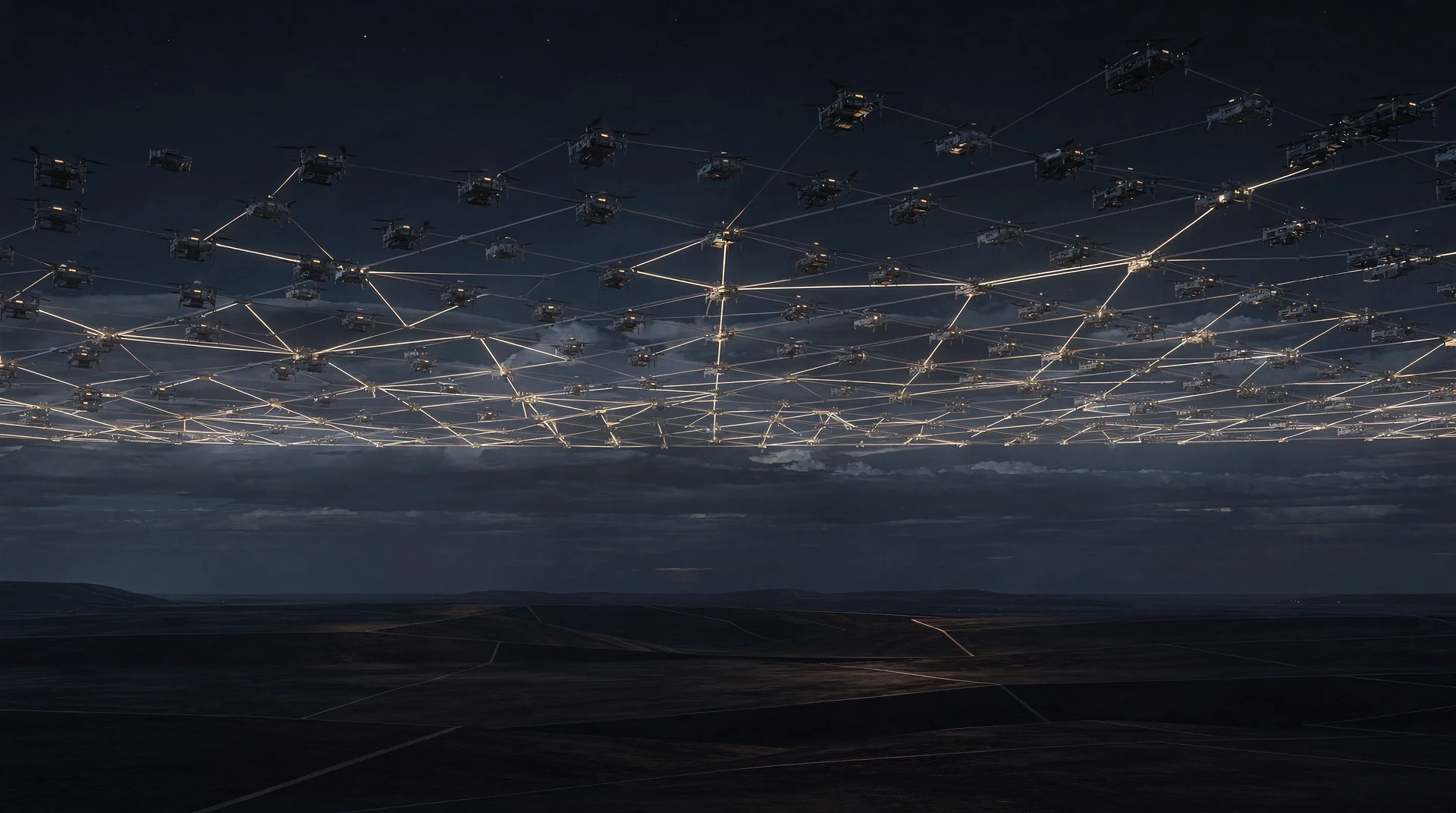
Swarmer Inc., which has conducted over 100,000 real-world combat drone missions in Ukraine since April 2024, surged 700% on its first trading day — the best US IPO debut since Newsmax. Simultaneously, a senior Defense official confirmed that the Pentagon is planning for AI companies to train models directly on classified data, shifting US military AI strategy from inference-only to active learning on sensitive datasets.
Note: These two developments tell one story: AI-enabled defense is no longer a procurement experiment — it is a publicly traded asset class and an active doctrinal priority. For EU institutions involved in defense procurement, civil protection, or dual-use research, the pace of military AI maturation sets the context for capability expectations and regulatory pressure.
Sources: Bloomberg, MIT Technology Review
The Workplace Shifts
Companies Are Now Tracking Individual Employee AI Token Usage
Organizations are beginning to monitor individual employees’ AI token consumption — identifying whose AI usage strategies are delivering value and whose represent waste or underutilization. The practice is emerging as a new layer of productivity management, distinct from traditional output metrics.
Note: Token tracking is a leading indicator of a broader shift: AI tool deployment without a measurement framework produces invisible results and uneven adoption. Institutions rolling out AI tools without usage analytics — or without a policy position on what monitoring is appropriate — will face this question as a governance issue, not just an IT one.
Sources: Wall Street Journal
SEC and CFTC Issue Token Taxonomy — Stablecoins, Collectibles, and Digital Commodities Carved Out as Non-Securities
The US Securities and Exchange Commission and Commodity Futures Trading Commission jointly released a digital asset taxonomy clarifying which token types fall under securities regulation. Stablecoins, digital collectibles, and digital commodities have been classified as non-securities, while the treatment of other token categories remains under review.
Note: US regulatory clarity on digital asset classification creates an immediate divergence with the EU’s MiCA framework, which has its own categorization logic. Institutions operating across both jurisdictions — or evaluating digital payment infrastructure — now face a compliance landscape where the same asset may be classified differently on each side of the Atlantic.
Sources: Bloomberg