Tech Digest – February 25, 2026
AI Governance & Data Sovereignty
Anthropic Drops Its Core Safety Pledge — Will No Longer Halt Training Over Inadequate Safeguards
Anthropic has removed the central commitment from its Responsible Scaling Policy: the 2023 pledge to never train or deploy an AI model unless safety mitigations were guaranteed in advance. Chief Science Officer Jared Kaplan told TIME the company felt it no longer made sense to “make unilateral commitments” while competitors raced ahead. The revised policy replaces hard triggers with transparency mechanisms — regular “Risk Reports” and “Frontier Safety Roadmaps” — but drops the binary halt threshold entirely. The decision was unanimously approved by CEO Dario Amodei and Anthropic’s board. METR’s policy director warned the shift signals that safety methodology is not keeping pace with capabilities.
Note: The company that invented the Responsible Scaling Policy just rewrote its own framework because voluntary self-restraint didn’t survive competitive pressure. For anyone building procurement criteria around vendor safety commitments, this is a data point: public pledges are not durable constraints.
Sources: TIME (exclusive), CNN
White House Orders Diplomats to Fight EU-Style Data Sovereignty Rules — Names GDPR as Target
A State Department cable signed by Secretary of State Marco Rubio directs U.S. diplomats to actively oppose foreign data sovereignty and localization laws, calling them threats to AI services, cloud computing, and cross-border data flows. The cable specifically names the EU’s GDPR as an example of “unnecessarily burdensome” regulation. Diplomats are tasked with monitoring proposals, lobbying against restrictions, and promoting the U.S.-backed Global Cross-Border Privacy Rules Forum as an alternative. Last year, Rubio ordered similar diplomatic opposition to the EU’s Digital Services Act.
Note: The cable names GDPR directly. Any European institution planning digital services around data sovereignty, European cloud, or GDPR-aligned procurement frameworks is now operating in an environment where these very frameworks are explicit diplomatic targets. The regulatory landscape you’re building on is being actively contested.
Sources: Reuters (exclusive), TechCrunch
The Cost of Building Just Dropped
Smaller Models Outperform Bigger Ones — Qwen 3.5 35B Beats Its Own 235B Predecessor
Alibaba’s Qwen 3.5 35B model now surpasses the company’s own Qwen 3 235B across benchmarks, demonstrating that architecture and data quality can beat raw scale by nearly 7x in parameter count. Separately, Inception Labs launched Mercury 2, a reasoning model that replaces autoregressive token generation with diffusion, claiming 5x faster output. Both signal that the performance curve is decoupling from model size.
Note: “Bigger model = better results” was already questionable. Now the vendor’s own smaller model outperforms the larger one. For anyone writing procurement specs around model size or compute requirements, the goalposts are moving fast — and in a direction that favors cost efficiency.
Sources: Qwen (official), Inception Labs
Cloudflare Engineer Rebuilds Next.js From Scratch With Claude — $1,100, One Week, 94% API Coverage
A Cloudflare engineering director used Claude to reimplement 94% of the Next.js API surface in roughly one week across 800+ AI coding sessions, spending approximately $1,100 in tokens. The result — an open-source project called Vinext — produces bundles 57% smaller and builds 4.4x faster than Next.js 16 with Turbopack. The project passes 1,700+ unit tests and 380 end-to-end tests. Cloudflare was transparent that almost every line was AI-written and that human code review was minimal — the test suite served as the primary quality gate.
Note: The interesting number isn’t $1,100. It’s the ratio: one person, one week, reimplementing a framework that took a company years to build. When reimplementation costs approach zero, the moat around “we already built it” collapses — and “build vs. buy” starts looking very different for any custom software project.
Sources: Cloudflare Blog, The Register
Anthropic Pushes Agentic AI Beyond Developers — Remote Control, Scheduled Workflows, Enterprise Plugins
Anthropic launched Remote Control for Claude Code, letting users kick off terminal tasks and manage them from a phone. More significantly, Cowork — Anthropic’s desktop automation tool — now supports scheduled workflows and plugin templates: pre-built connectors for specific industry workflows including investment banking, private equity, wealth management, and HR. Plugins let non-technical professionals set up autonomous agents that handle recurring tasks at scheduled times without writing code. This extends the agentic AI pattern — kicked off in public conversation by OpenAI’s Open Claw agents — from developers to broad professional use.
Note: The trajectory is clear: every frontier lab is building toward autonomous agents that non-developers can deploy. Once scheduled agents running enterprise workflows become reliable and widely adopted, the operational assumptions behind staffing plans, process design, and vendor contracts all shift. This isn’t a developer tool story anymore.
Sources: Claude (official), Claude Blog
Workforce Signals
Microsoft Execs Warn: AI Boosts Seniors, Drags Juniors — and Companies Are Cutting Entry-Level Anyway
Azure CTO Mark Russinovich and VP Scott Hanselman published a paper in ACM arguing that agentic coding assistants multiply senior engineers’ output while imposing an “AI drag” on early-career developers who lack the judgment to steer AI-generated output. Russinovich said the finding is “a hot topic in all our customer engagements — they all say they see it at their companies.” The paper calls for a “preceptor-based” model where seniors mentor juniors through AI-assisted workflows — but acknowledges the economic pressure runs the other way: Microsoft itself cut software engineering roles last year.
Note: The skills gap isn’t between “can use AI” and “can’t.” It’s between “can evaluate AI output” and “can’t.” That distinction has direct implications for training budgets and hiring criteria — in tech and eventually in every field where AI tools are deployed.
Sources: ACM, The Register
AI Predicts 71% of Fund Manager Trades — PE Firms Discuss Not Needing Associates
A Harvard Business School study published via the National Bureau of Economic Research found that a neural network trained on 1990–2023 data can predict 71% of active mutual fund trading decisions. For some managers, the model predicted nearly all trades in a given quarter. The unpredictable 29% — where human judgment diverged from patterns — was associated with outperformance. Separately, private equity firms are reportedly holding “firm-wide meetings about how we don’t need associates anymore,” according to a widely circulated account from an industry insider.
Note: The Harvard finding has a twist worth reading carefully: the most predictable managers underperform, while the least predictable ones outperform. The AI doesn’t replace judgment — it exposes where judgment was never being applied. That logic extends well beyond finance.
Sources: Bloomberg, Fast Company
Generational Shift
64% of US Teens Now Use AI Chatbots — 12% for Emotional Support
A Pew Research Center survey of 1,458 U.S. teens (ages 13–17) found that 64% use AI chatbots, with 30% using them daily. Over half (54%) use chatbots for schoolwork, and 12% turn to them for emotional support or advice. One in ten teens say they complete all or most of their schoolwork with chatbot assistance. Parents consistently underestimate usage: only 51% believe their teen uses chatbots, while 64% actually do. ChatGPT dominates at 59% of teen chatbot users, with Google Gemini at 23%.
Note: These are your future citizens, employees, and service users. They already expect instant, conversational digital interactions as the default. The gap between what they’re used to and what most public service portals offer is going to feel wider every year.
Sources: Pew Research Center
Infrastructure & Energy
UK Data Centers Could Double National Electricity Use — Ofgem Warns of 50 GW Demand
Britain’s energy regulator Ofgem warned that 140 proposed data center schemes could require up to 50 GW of power, potentially doubling the UK’s peak electricity demand. In the U.S., President Trump used his State of the Union address to announce a “rate payer protection pledge” requiring hyperscale tech companies to build their own power plants rather than drawing from the public grid. The policy signals growing political pressure around who pays for AI’s energy footprint.
Note: The question is no longer whether AI will reshape energy infrastructure — it’s who bears the cost. Ofgem’s 50 GW figure is for the UK alone. EU member states face the same pipeline of applications. Energy policy and digital policy are now the same conversation.
Sources: The Guardian, Reuters
CoreWeave Raises $8.5B, Meta Signs $100B+ AMD Deal, Texas Becomes World’s Largest Data Center Market
CoreWeave is raising $8.5 billion in debt backed by its Meta contract. Meta has agreed to a deal with AMD worth over $100 billion for 6 GW of Instinct GPUs — a transaction large enough to hand Meta roughly 10% of AMD’s stock. Meanwhile, Texas has overtaken Virginia as the world’s largest data center market, marking an inflection point in how compute infrastructure is distributed geographically. Data center expansion has reached what CNBC describes as an “inflection point,” with capital deployment now reshaping energy grids, real estate markets, and semiconductor supply chains simultaneously.
Sources: Bloomberg, Wall Street Journal, CNBC
US Plans Record 86 GW of New Power Capacity — Form Energy Deploys World’s Largest Battery at 30 GWh
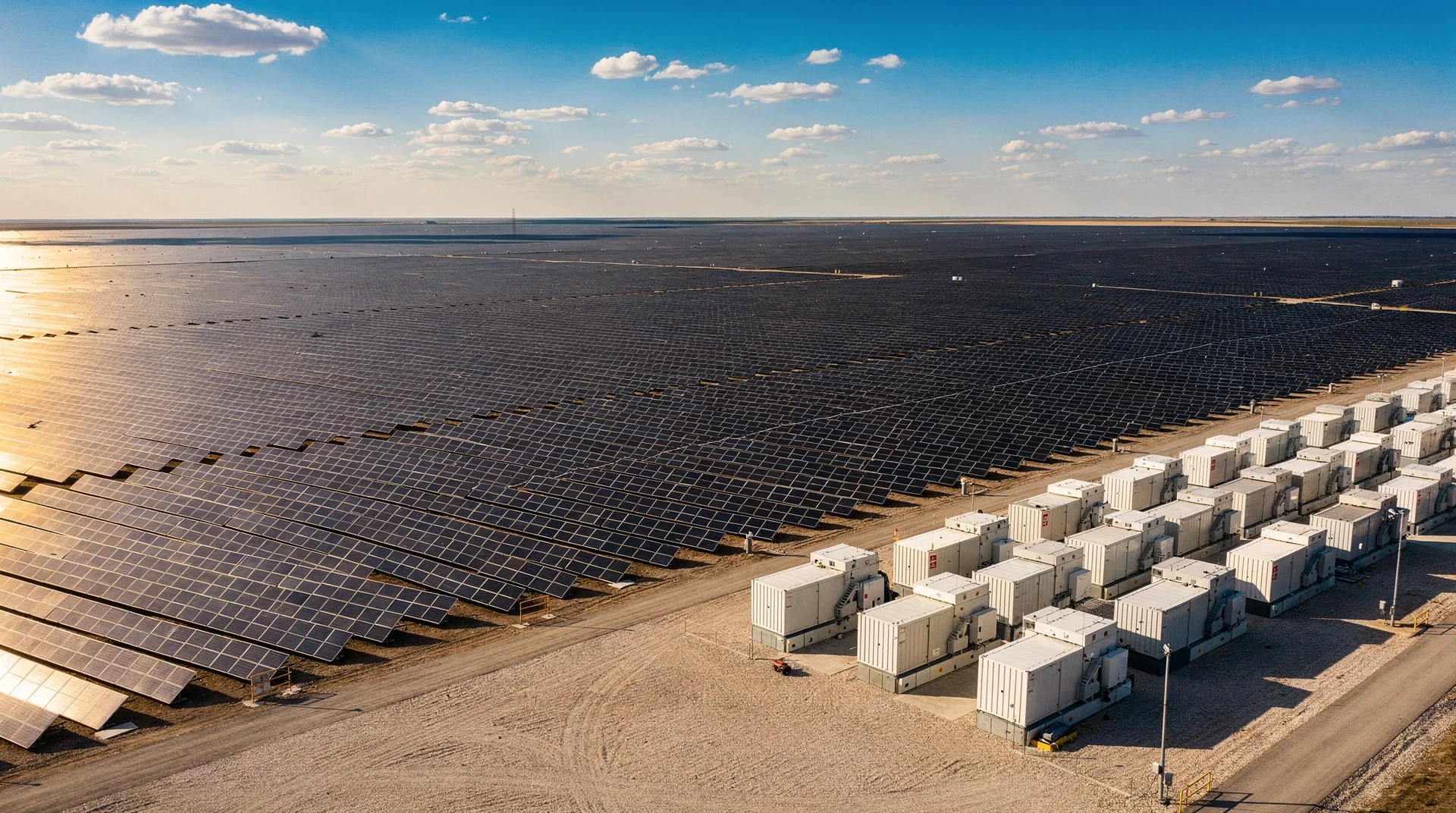
The U.S. Energy Information Administration projects 86 GW of new electricity generation capacity coming online in 2026 — a record. The mix: 51% solar, 28% battery storage, 14% wind. Separately, Form Energy announced it will deploy a 300 MW / 30 GWh multi-day iron-air battery system with Xcel Energy to power a Google data center in Minnesota. At 30 GWh, it is the largest battery system by energy capacity ever announced globally. The technology stores energy for days rather than hours, addressing a key limitation of lithium-ion storage.
Note: 86 GW in a single year, and it’s still not enough — data center demand projections keep outrunning supply additions. The Form Energy deployment matters because multi-day storage at this scale changes what’s possible for renewable-powered compute. Watch whether European utilities follow.
Sources: U.S. Energy Information Administration, Form Energy (official)