Tech Digest – March 3, 2026
When Cloud Has a Physical Address
AWS Data Centers Hit by Drones — First Military Strike on a Major Cloud Provider
Two AWS data centers in the UAE and one in Bahrain were struck by drones amid escalating Iranian military action — the first time armed conflict has physically disrupted a major cloud provider’s infrastructure. Separately, Israel deployed its Iron Beam laser defense in combat for the first time, intercepting Hezbollah rockets at roughly $4 per shot compared to $50,000 per Iron Dome missile.
Note: Every institution running workloads on a hyperscaler just received a live demonstration that “the cloud” is concrete, copper, and cooling towers in a specific postal code. Geographic redundancy moved from best practice to operational necessity overnight.
Sources: Business Insider, Ynet News
OpenAI’s Pentagon Deal Stumbles as Anthropic Quietly Pitched Drone Swarms
Sam Altman publicly admitted OpenAI’s rush to secure a Pentagon partnership after Anthropic was blacklisted “looked opportunistic and sloppy,” announcing Fourth Amendment safeguards after a wave of ChatGPT cancellations. Meanwhile, Bloomberg reported that Anthropic itself had pitched the Pentagon’s $100 million drone swarm contest, proposing Claude to coordinate drone fleets while explicitly excluding autonomous targeting — though it was not selected.
Note: The governance norms being set in defense procurement today — human-in-the-loop requirements, Fourth Amendment constraints, targeting exclusions — will cascade into civilian AI procurement standards within a few budget cycles. Pay attention to the language being used now.
Sources: Sam Altman (X), Bloomberg
Intelligence Gets Smaller, Faster, Cheaper
AI Formalizes Fields Medal Proof in Two Weeks — and Catches Two Errors
Math, Inc.’s Gauss system completed a Lean formalization of Maryna Viazovska’s 2022 Fields Medal-winning sphere packing proof — 200,000+ lines of verified code, produced in two weeks. The process caught two errors in the original human arguments. Even skeptic Daniel Litt, a mathematician who had publicly questioned AI formalization claims, called it the first truly autonomous formalization of a substantial result.
Note: The headline is the proof. The signal is the error-catching. Automated verification finding mistakes in expert human work is an audit capability — and it extends well beyond mathematics.
Sources: Math, Inc. (X), Daniel Litt (X)
Qwen 3.5 Small Models: 4B Parameters Now Match Previous 80B Performance
Alibaba released the Qwen 3.5 Small Series — four open-source models at 0.8B, 2B, 4B, and 9B parameters, all natively multimodal with 262K token context. The 4B model nearly matches the performance of the previous-generation 80B model. The 9B outperforms GPT OSS 120B on graduate-level reasoning benchmarks at 13x smaller. All four run on consumer hardware, phones included, under the Apache 2.0 license.
Note: A year ago, this capability required a server room. Now it runs on a laptop with no internet connection. When your next device refresh lands, the hardware you’re already buying may come with AI capability that didn’t exist at procurement time.
Sources: Qwen (X), VentureBeat
Apple’s M4 Neural Engine: An 80x-More-Efficient AI Accelerator Hiding in Hundreds of Millions of Devices
A solo researcher, working with Claude Code, ran Karpathy’s llama2.c transformer on Apple’s M4 Neural Engine at less than one watt — by reverse-engineering undocumented Apple APIs. The result: an AI accelerator 80 times more power-efficient than an Nvidia A100, already embedded in hundreds of millions of shipping devices, almost entirely unused.
Note: Institutional hardware budgets assume AI needs new infrastructure. This suggests the opposite — dormant capability is already deployed at scale, waiting for someone to turn it on.
Sources: Anand Iyer (X)
Platform Economics & Lock-In
Claude Goes Down for Three Hours as Users Flee ChatGPT — and Anthropic Launches a Migration Tool
Anthropic’s Claude suffered a three-hour outage amid an unprecedented demand surge, driven in part by users leaving ChatGPT following OpenAI’s Pentagon controversy. Anthropic responded by launching a memory import tool that lets users port conversation data from ChatGPT, Gemini, and Copilot. Meanwhile, two Claude Code instances told to “find each other and build something” — with no other instructions — invented a 2,495-line programming language in 12 minutes.
Note: AI platforms now compete for user lock-in with data portability tools — the same pattern that defined cloud migration a decade ago. The outage is a reminder that concentration risk applies to AI providers exactly as it does to cloud vendors.
Sources: MarketWatch, Anthropic, Dimitris Papailiopoulos (X)
Apple Using Just 10% of Its $4.5 Billion AI Cloud
Apple’s Private Cloud Compute infrastructure — built at a reported cost of $4.5 billion — is running at roughly 10% utilization. The hardware works. Demand hasn’t followed.
Note: Building the infrastructure is the easy part. Getting people to actually use it is the transformation — and it doesn’t come bundled with the purchase order.
Sources: 9to5Mac
Compute Is Now a Traded Commodity: First Regulated H100 Futures Contracts
Ornn and Kalshi launched the first CFTC-regulated price contracts for Nvidia H100 GPU compute time. Compute — previously a line item in a cloud invoice — can now be priced, hedged, and speculated on like electricity or crude oil. (Disclosure: The Innermost Loop author has a financial interest in Ornn.)
Note: When something gets a futures market, it has become infrastructure. Procurement teams that treat compute as a commodity — not a vendor relationship — will have more leverage in negotiations.
Sources: Kalshi
Rebuilding the Physical Layer
Nvidia Commits $4 Billion to Optical Interconnects as ASML Pushes Beyond EUV
Nvidia committed $4 billion to Lumentum and Coherent to develop next-generation optical interconnects for AI data centers. Separately, ASML is pushing beyond extreme ultraviolet lithography into advanced packaging and third-generation optics — signaling that the semiconductor supply chain is being fundamentally rebuilt around photonic technology.
Note: The physical layer under AI is being redesigned from the chip to the cable. Any institution planning a multi-year digital infrastructure project should understand that the hardware landscape at project completion will look nothing like it does at project kickoff.
Sources: Reuters (Nvidia/Lumentum), Reuters (ASML)
765-kV Power Lines Return After 40 Years — AI Demand Triggers $11.8 Billion Grid Expansion
AI data center demand is reviving extra-high-voltage 765-kV transmission lines not built in the United States since the 1980s. Grid operator PJM approved $11.8 billion in expansion to carry the load. The last time infrastructure of this class was commissioned, it was built for heavy industry and nuclear power.
Note: The energy footprint of AI is no longer a projection in a white paper — it is reshaping physical infrastructure at a scale and cost that invokes comparisons to mid-century electrification. Twin transition planning that treats energy and digital as separate tracks is already behind.
Sources: The Information
Legal Precedent
Supreme Court Cements: No Copyright for AI-Generated Works
The U.S. Supreme Court declined to hear an appeal seeking copyright protection for AI-generated artwork, leaving in place a legal regime in which purely AI-generated works cannot receive copyright. The decision closes — for now — the question of whether output created without human authorship qualifies for intellectual property protection.
Note: If your institution uses AI to draft documents, designs, or communications, those outputs may not be protectable. Content strategy, procurement specs, and IP policies all need updating — not eventually, now.
Sources: Reuters
Robotics Crosses the Production Line
Xiaomi Humanoid Runs a Real Factory Shift: 3 Hours, 90%+ Accuracy, On the Production Line
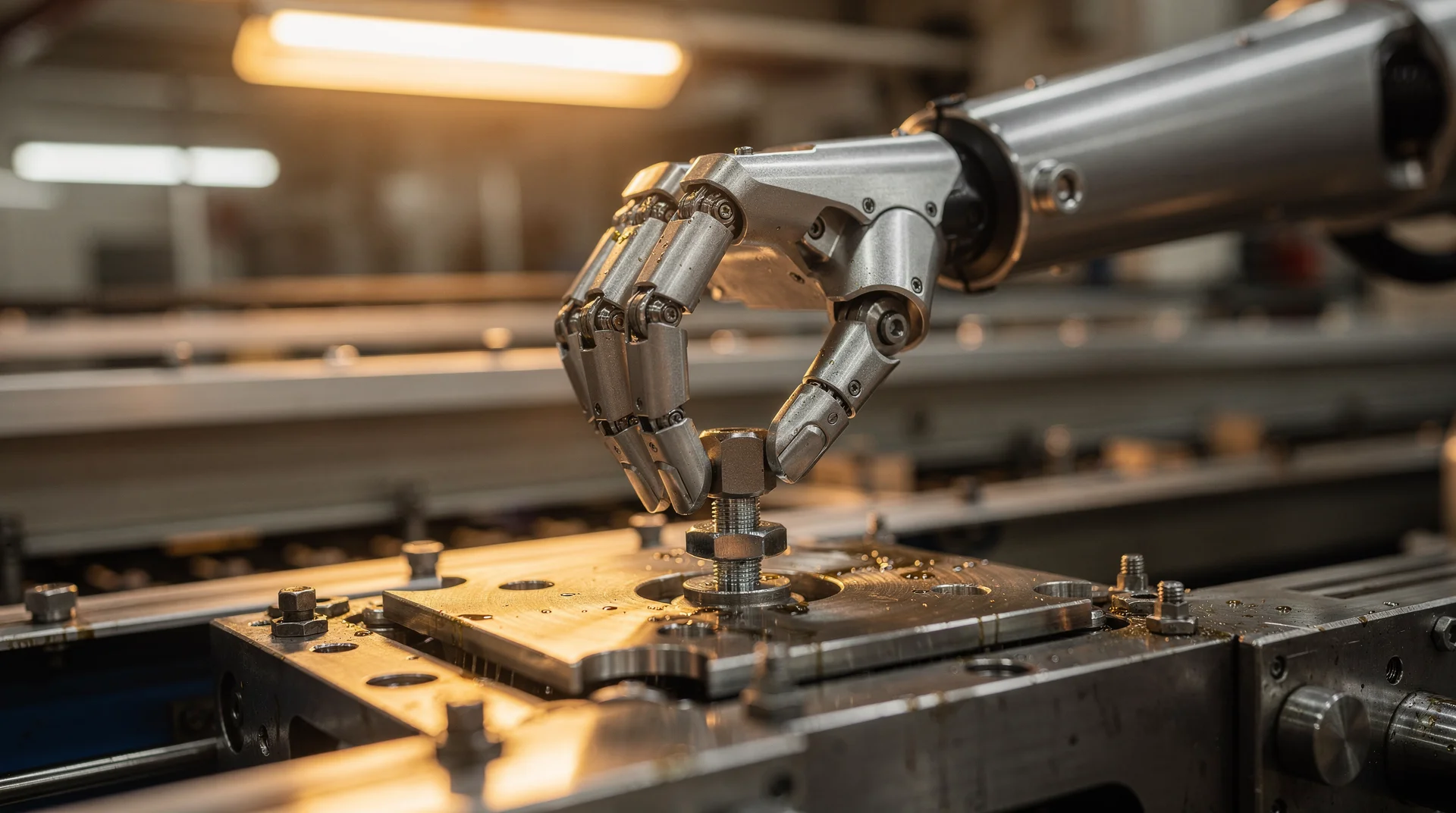
Xiaomi’s humanoid robot completed a three-hour autonomous test in an actual car factory, installing self-tapping nuts at 90%+ accuracy while keeping pace with the production line’s 76-second cycle time. This is not a controlled demo environment — it is a production line with real tolerances and real deadlines.
Note: Three hours is a shift segment. 90% is not perfect — but it’s the kind of number that improves with every firmware update. The question for workforce planning is not “will robots replace factory workers” but “how fast does 90% become 99%?”
Sources: CyberRobo (X)