Tech Digest – June 20, 2026
The AI Platform Shake-Up
Nobel Laureate Jumper Defects to Anthropic as Google Loses Two Top Researchers in One Week
John Jumper, who shared the 2024 Nobel Prize in Chemistry for AlphaFold, is leaving Google DeepMind after nearly nine years to join Anthropic. His departure comes days after Noam Shazeer — co-lead of Google’s Gemini models and co-author of the foundational Transformer paper — announced his own move to OpenAI. Inside DeepMind, morale has reportedly slid into “frustration and broad discontent,” with Google’s best model now sitting fifth on the intelligence index, behind both US rivals and China’s Zhipu.
The talent is flowing toward Anthropic even as the company navigates political turbulence. President Trump told Axios this week that he had briefly viewed Anthropic as a national security threat — before warming to CEO Dario Amodei and declining to rule out the Defense Production Act.
Note: One Nobel laureate leaving a lab is personal. Two top researchers leaving in one week — one to each of your two main competitors — is structural. For institutions choosing between Google Workspace AI and rival platforms, where the talent goes is a leading indicator of which platform will improve fastest.
Sources: Bloomberg, CNBC, TechCrunch, Axios
Chinese Open Models Command 61% of Global AI Traffic — At a Fraction of the Cost
Chinese AI models — Qwen, DeepSeek, Kimi, GLM, and MiniMax — now account for 61% of token consumption among the ten most-used models on OpenRouter, up from under 2% in late 2024. The cost advantage is stark: Chinese models run 10 to 20 times cheaper than Western frontier equivalents. Yesterday in this digest, Zhipu’s GLM-5.2 ranked third on sustained knowledge work and fit on a single server. A former DeepMind VP has called it the first open model good enough to use as a daily driver.
Note: The procurement equation has flipped: the question isn’t whether open models are good enough, but whether the data governance framework is ready. Routing institutional workloads through Chinese-hosted models at a twentieth of the cost raises sovereignty questions the AI Act and Data Act haven’t fully resolved.
Sources: NDTV Profit, VentureBeat
Humanoids Hit Factory Scale
Robots Outnumber Humans at Figure as Hyundai Takes Full Control of Boston Dynamics
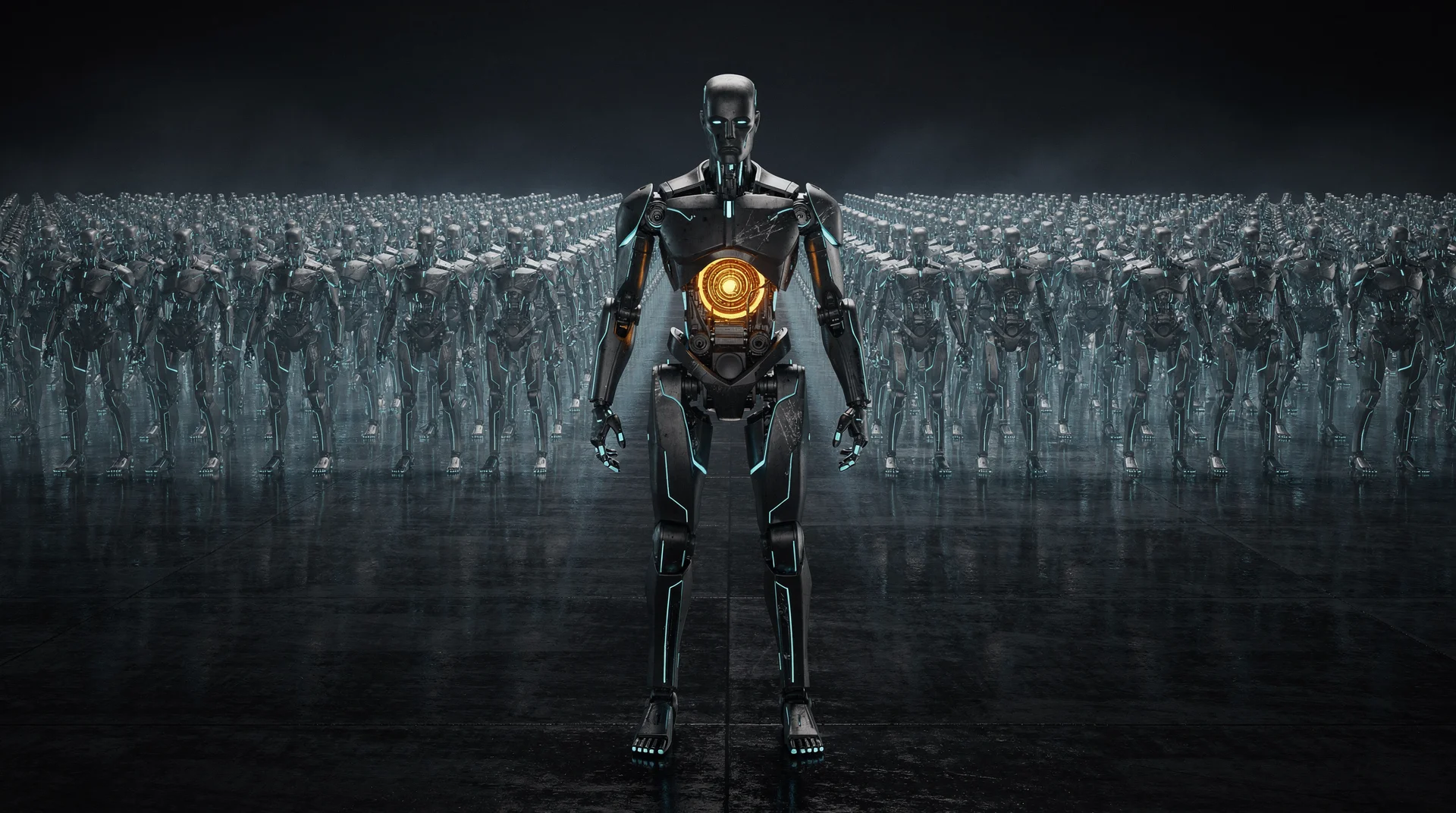
At Figure, CEO Brett Adcock announced that robots now outnumber human workers — a milestone for any company deploying humanoids at operational scale. Separately, Hyundai is acquiring SoftBank’s remaining 9.65% stake in Boston Dynamics for $325 million, making the robotics company a wholly owned subsidiary. Boston Dynamics has moved its electric Atlas humanoid from demonstration to commercial production, with plans for a factory capable of building 30,000 humanoids a year. Atlas is slated to begin work at Hyundai’s Metaplant facility in Georgia by 2028.
The missing capability was always dexterity. A Berkeley, NVIDIA, and Stanford team published T-Rex, a tactile sensing system that lets two-handed robots react to touch in real time, outperforming the strongest baseline by 30 points across a dozen delicate tasks — from transferring an egg to inserting a USB cable.
Note: 30,000 humanoids a year from one factory. For anyone budgeting facility maintenance, warehousing, or logistics staff on a five-year horizon, the substitution timeline now has industrial manufacturing behind it.
Sources: Brett Adcock (Figure), Hyundai Newsroom, T-Rex (Berkeley/NVIDIA/Stanford)
Powering the Build-Out
Tech Giants Tap Bond Markets for AI Data Centres as Nuclear Reactor Goes Critical in Utah
Technology companies are increasingly turning to the bond market to fund AI data-centre construction, at a moment when the Federal Reserve — under chair Kevin Warsh — is signalling a possible 2026 rate hike that has pushed the 10-year Treasury yield toward 4.45%. The cost of capital for AI infrastructure is rising just as the build-out accelerates.
On the power side, Valar Atomics achieved criticality at Ward 250 — a minivan-sized TRISO-fueled microreactor capable of generating 5 MW, airlifted to Utah’s San Rafael Energy Lab by a C-17 military cargo plane. It is the second advanced reactor to go critical under Executive Order 14301, which directed three reactors to reach criticality by July 4, and the first ever built and operated outside the national laboratory system.
Note: Yesterday this digest tracked European nuclear revival — Sweden’s first new capacity in 40 years, Switzerland lifting its post-Fukushima ban. Today, a reactor small enough to be airlifted goes critical in Utah. The infrastructure stack powering AI is becoming as consequential as the models themselves.
Sources: CNBC, Power Magazine
Defence & Tech Sovereignty
Ukraine Opens Captured Russian Weapons to Allied Labs
Ukraine’s Minister of Digital Transformation Mykhailo Fedorov announced TrophyLab, a secure platform that gives allied governments, defence companies, and research labs access to captured Russian missiles, drones, and vehicles. Every component, vulnerability, and reverse-engineering finding from battlefield salvage is made available to partners — treating seized military hardware as shared intelligence rather than classified inventory.
Note: Open-sourcing captured military technology is a new model for defence cooperation — less classified vault, more shared lab.
Sources: Mykhailo Fedorov (Ukraine)
Russia Builds Domestic AI Under Sanctions — Constrained by the Chips It Can’t Buy
Russia is pursuing AI sovereignty through a new faculty at Moscow State University and an ecosystem partly steered by Maria Vorontsova, identified by Western media as Putin’s daughter. The effort spans domestically trained models and government-backed AI deployment across public services. The binding constraint remains advanced semiconductors — the chips that Western sanctions keep out of reach limit what Russian-built systems can achieve at the frontier.
Note: The ambition isn’t in doubt — the constraint is physical. For the EU, the lesson runs both directions: technological sovereignty requires domestic capability and reliable access to the global semiconductor supply chain. One without the other produces the bottleneck Russia now faces.
Sources: Time
Societal Guardrails
Norway Bans Generative AI in Elementary Schools as Test Scores Slide
Prime Minister Jonas Gahr Stoere announced a near-total ban on generative AI tools in Norwegian schools for children in grades one through seven, ages six to thirteen, effective this autumn. Students aged 14 to 16 may use AI under teacher supervision; those 17 and above are encouraged to use it independently. Norway banned smartphones from schools in 2024 — a move widely regarded as successful — and frames the AI restrictions as a response to declining test scores and a conviction that children must first learn to read, write, and do mathematics without shortcuts.
Note: Norway banned smartphones in 2024. Now generative AI for under-13s. The question for EU and EEA education ministries isn’t whether to act, but which of Norway’s outcomes — smartphone ban data is already in — will shape their own timelines.
Sources: Reuters, The Decoder
Commonwealth Short Story Prize Engulfed After Winner Flagged as AI-Written
The Commonwealth Short Story Prize is in crisis after Jamir Nazir’s winning entry in the Caribbean category was flagged by an AI detection platform as likely machine-generated. Granta publisher Sigrid Rausing acknowledged the prize may have been awarded to “an instance of AI plagiarism” but conceded “we don’t yet know, and perhaps we never will know.” The controversy follows Hachette’s April decision to pull a novel from bookshops after a separate detection tool rated it 78% AI-generated.
Note: When detection tools disagree with each other — and the defence is that an AI model itself assessed the work as human-written — every institution running a submission process, grant programme, or content award faces the same unresolvable question. The technology that generates the work is advancing faster than the technology that detects it.
Sources: The Guardian
Today’s digest reads like a system reorganising under pressure. The AI labs are reshuffling talent and models at a pace that makes last quarter’s platform rankings unreliable. The hardware stack — from bond-financed data centres to airlifted nuclear reactors — is scaling on timelines that would have seemed implausible two years ago. And on the societal front, institutions from literary prizes to elementary schools are discovering that the frameworks built to manage the last era don’t hold. What connects these threads isn’t disruption — that word has lost its meaning — it’s the speed at which the ground shifts beneath planning assumptions written last year.